Readers of my reading blog know I love The Why Files, now here's a reason for writers to love it too: the awesome science team at University of Wisconsin-Madison recently highlighted its Classroom Activity Pages in its newsletter, and what a line-up! From amoebas to tsunamis, children's writers are sure to find those pages an excellent resource.
_______________________
Link not working? Here's the URL:
http://whyfiles.org/category/cap/?orderby=rand
Showing posts with label writing. Show all posts
Showing posts with label writing. Show all posts
Monday, April 16, 2012


Tuesday, August 30, 2011
Quickie tip: on perspective and creating an elevator speech
Rarely does advice on voice and perspective come in such practical terms: if you're a writer, of white papers or web content or Facebook pages or flash fiction or just about anything else, I bet you'll appreciate this blog post from Jonathan Hop. (Thanks, Jonathan)
I'm looking forward to using this technique as I review and revise my (admittedly lackluster) elevator speech.
So... who wants to share their elevator speech?
I'm looking forward to using this technique as I review and revise my (admittedly lackluster) elevator speech.
So... who wants to share their elevator speech?
Friday, February 25, 2011
TODAY AT 1PM EST: Borders Closing & Fallout for Writers
Pre-registration is required for this free, one-hour webinar, hosted by Writer's Digest, featuring experts from leading publishers:
https://www1.gotomeeting.com/register/127220697
If you're querying agents or publishers, this will probably be a good investment of your time.
https://www1.gotomeeting.com/register/127220697
If you're querying agents or publishers, this will probably be a good investment of your time.
Monday, March 1, 2010
Fiction Habit: Critiquing what isn't there
I'm fortunate to be a member of a very talented online critique group. What I've learned from the group over the years could fill a book. But cursed as I am, a copywriter with a fiction-writing habit, I won't have time to write that book for many years. *sigh* Anyway....
One of the many invaluable things a critique group can do is point out what isn't in a manuscript that should be. More than those nagging questions (what happened to the donkey on page 7?) I'm talking about things like missing elements. Believability. Conflict. An arc. A resolution. If you write without an outline (as I believe most fiction writers do) it is possible to write a story without a very important ingredient. It might look good, but there's a missing ingredient. Think chocolate cake without sugar. Leaves a bad taste in your mouth, you know?
On the other hand, a critique group can also consider what you've (perhaps purposely) omitted and give you an honest assessment regarding its relative necessity. As a story sweeps the reader along, a lot of little details can and should be left out. What kind of shoes the main character is wearing, what he had for breakfast, and whether or not he crossed at the light or brazenly jaywalked.
If you, the writer, have glossed over a detail that needs clarification, however, it's the crit group's responsibility to call you on it. (You need to explain how the donkey got from Milwaukee to Martinique.)
And yes, it will sting. That's when you say "thank you," and put the manuscript in a drawer, figuratively or literally, for 24 hours. (Of course I recommend you save it to your external hard drive; don't get me started on back-up issues.) Then, get your red pen, and get the donkey home.
Tuesday, February 16, 2010
3-minute inspiration
Writers, NPR is doing you a tremendous favor. All you have to do is come up with a 600-word (or shorter) story, inspired by the picture provided here. Too lazy to enter? You can tickle your muse by reading recent winners and the judges' comments on why those particular stories rose to the top.
Monday, February 1, 2010
Journalists can't protect society...
...if they can't protect their own careers. -- from a post at Reflections of Newsosaur, one of the most on-target and depressing things I've read about the news biz recently.
Thursday, November 19, 2009
Practical Intro to Using Social Media
Outback Steakhouse is one company that's gotten a bang for its buck using Twitter and Facebook. But scads of companies are wasting their time (and $$) on social media "campaigns" that are just so much cyber-waste.
If you're in marketing/advertising/pr (or advising someone who is) I urge you to read this marketing brief from motivelab, which, before it launches into some very practical advice, acknowledges that social media is just good-old-fashioned word-of-mouth with a much speedier delivery mechanism, thanks to current technology.
Why it's worth the download and some thoughtful consideration: it reminds us how to use the old tried and true marketing theories online, on mobile devices, and such. Clarify your positioning is good advice that will never go out of style; figuring out how to do it (and not muck it up) using social media vehicles is what writers need to know, now.
As the article points out, very wisely, "Ultimately, your most influential audience are human beings, not computers, so don't let your SEO ambitions take the life out of your blog."
Of course, I translate that sentence into "content is still king." (If you've been paying attention, you're not surprised.)
If you've got a solid grounding in advertising or copywriting, do you need to read this? Yes. There are plenty of new twists marcomm writers need to understand.
For example, we still need to leverage the one- or two-percent response to convert good marketing into better sales.
See, the game hasn't changed; social networking is just like the new sharkskin-inspired swimsuit - and we all have to swim a little faster now.
If you're in marketing/advertising/pr (or advising someone who is) I urge you to read this marketing brief from motivelab, which, before it launches into some very practical advice, acknowledges that social media is just good-old-fashioned word-of-mouth with a much speedier delivery mechanism, thanks to current technology.
Why it's worth the download and some thoughtful consideration: it reminds us how to use the old tried and true marketing theories online, on mobile devices, and such. Clarify your positioning is good advice that will never go out of style; figuring out how to do it (and not muck it up) using social media vehicles is what writers need to know, now.
As the article points out, very wisely, "Ultimately, your most influential audience are human beings, not computers, so don't let your SEO ambitions take the life out of your blog."
Of course, I translate that sentence into "content is still king." (If you've been paying attention, you're not surprised.)
If you've got a solid grounding in advertising or copywriting, do you need to read this? Yes. There are plenty of new twists marcomm writers need to understand.
For example, we still need to leverage the one- or two-percent response to convert good marketing into better sales.
See, the game hasn't changed; social networking is just like the new sharkskin-inspired swimsuit - and we all have to swim a little faster now.
Tuesday, July 28, 2009
Words I Didn't Know
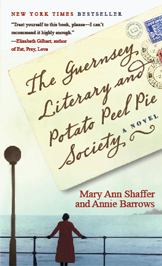 I love a few "new" words sprinkled in a good book... at least, I love them when I recover from my initial feelings of stupidity.
 So here they are, the words I had to look up, from The Guernsey Literary and Potato Peel Pie Society:
fulsome
metier
melange
mien
tractable (I think I learned, and then forgot, that one)
vociferous (ditto this one)
The new (to me) vocabulary words were used perfectly, when each was the absolute right word to use. Writers who do that further communication in general and the art of writing in particular. I am in awe of (and grateful to) Mss. Barrows and Shaffer for producing such a fine book.
Think you can produce writing of a similar ilk? Try - for the month of August, Random House is soliciting entries for its The Guernsey Literary and Potato Peel Pie Society Essay Contest. Contestants should describe, in 430 words or less, their favorite book and what it taught them about a particular place and/or time period. Pens at the ready - and good luck!
Sunday, June 7, 2009
You Know What Copywriting Is
"It's copywriting," I said, in a like, duh tone of voice.
"Why do they call it copyrighting?"
I was surprised to get this question from a friend and college professor the other night. It took us a brief who's-on-first-like exchange before I realized he'd heard me say copyrighting when I meant copywriting.
Copywriting is what's on the back of cereal boxes and book jackets and all over the Greenpeace website. It's advertising, PR, puff, and when done right, it's persuasive stuff.
Sadly, it's also a much more lucrative calling than journalism. (Don't get me started.) Anyway, I bring this up because there's a rather nice review of positioning (a very important concept copywriters better understand) here.
"Why do they call it copyrighting?"
I was surprised to get this question from a friend and college professor the other night. It took us a brief who's-on-first-like exchange before I realized he'd heard me say copyrighting when I meant copywriting.
Copywriting is what's on the back of cereal boxes and book jackets and all over the Greenpeace website. It's advertising, PR, puff, and when done right, it's persuasive stuff.
Sadly, it's also a much more lucrative calling than journalism. (Don't get me started.) Anyway, I bring this up because there's a rather nice review of positioning (a very important concept copywriters better understand) here.
Sunday, May 24, 2009
Working With Lawyers
Some things must be written for lawyers; fewer things must be written by lawyers. Take employee handbooks. Those must be written for employees, with help from lawyers. Read more on that good advice from SHRM here. (free registration required)
On the one hand, SHRM argues, the employee handbook should be a welcoming document, guidelines giving a framework to life inside the organization (virtually or in the flesh). When lawyers write guidelines, they're rarely welcoming or friendly. And in spite of their best intentions, lawyers can write their way into legal trouble, says SHRM.
For years, I struggled to write for the intended readers and "around" the lawyers.
Unfortunately, I rarely hear from the client's clients - but I hear from the lawyers regularly. Fortunately (for the intended newsletter audience) somewhere along the way I realized that those readers need suggestions that have passed the legal test. Otherwise, they can't heed the advice without running it by council. Obvious? Well, maybe to you. But I have to say it was an AHA! moment for me. And while I still struggle to write the monthly and quarterly newsletters, it's different now.
Now when I pound out those articles, I try to imagine we're working as a team, those lawyers and I. We're not developing a long list of "don'ts," we're offering a legally-insulating "to-do" list. There still are mushy words like "may" and "should" when I really want to write "will" and "should," but you won't find a "heretofore" or "whereas" in my copy.
Because while the party of the first part and the party of the second part may not be having a party, at least we can work together.
On the one hand, SHRM argues, the employee handbook should be a welcoming document, guidelines giving a framework to life inside the organization (virtually or in the flesh). When lawyers write guidelines, they're rarely welcoming or friendly. And in spite of their best intentions, lawyers can write their way into legal trouble, says SHRM.
Overly legalistic language can make a handbook impenetrable to most employees and might wind up doing more harm than good when there is a legal challenge... (and) wind up unduly limiting the employer’s discretion.---SHRM vol 54 no 5, May 1, 2009Writing for lawyers can be a drag, frankly. I've done it for more than a decade for one client in particular, whose newsletters must pass legal review before being sent to the intended audience.
For years, I struggled to write for the intended readers and "around" the lawyers.
Unfortunately, I rarely hear from the client's clients - but I hear from the lawyers regularly. Fortunately (for the intended newsletter audience) somewhere along the way I realized that those readers need suggestions that have passed the legal test. Otherwise, they can't heed the advice without running it by council. Obvious? Well, maybe to you. But I have to say it was an AHA! moment for me. And while I still struggle to write the monthly and quarterly newsletters, it's different now.
Now when I pound out those articles, I try to imagine we're working as a team, those lawyers and I. We're not developing a long list of "don'ts," we're offering a legally-insulating "to-do" list. There still are mushy words like "may" and "should" when I really want to write "will" and "should," but you won't find a "heretofore" or "whereas" in my copy.
Because while the party of the first part and the party of the second part may not be having a party, at least we can work together.
Saturday, March 7, 2009
What Are Words For?
Missing Persons asked the question, What Are Words For? in the early 80s, and it seems we're still asking. Stupid, stupid, stupid.
The answer is, words are for human communication.
I hope you'll forgive me when the question "is content still king??" makes me roll my eyes and spew sarcastic sound bites. Such as, well, you only need content...if you want to communicate.
Full disclosure: I'm a writer who just laid off from a company (Viacom) that recently hired a half-dozen (more) SEO/Social Media Marketing gurus.
Sour grapes? No!
We need SEO that works. We don't live to search, we live to find. And what we're looking for - in a gazillion different forms - is content. Ergo, good SEO is pointless without good content.
Content, of course, can be a picture, a game, a form, a joke, King Lear or step-by-step instructions on hotwiring a car.
I think we've heard the "reading is dead" argument enough over the centuries (Plato?) to realize it's not. I think content is still king as long as SEO marketing firm Best Rank (and others) say it is. True, content has taken a hit in accounting. But even as stately old newspapers are disappearing others are starting to ask the right questions, like: what about distribution? and how can the print product add value to the web product? Aha! Now we're getting somewhere!
(But where? It's hard to say. Just keep reading.)
The answer is, words are for human communication.
I hope you'll forgive me when the question "is content still king??" makes me roll my eyes and spew sarcastic sound bites. Such as, well, you only need content...if you want to communicate.
Full disclosure: I'm a writer who just laid off from a company (Viacom) that recently hired a half-dozen (more) SEO/Social Media Marketing gurus.
Sour grapes? No!
We need SEO that works. We don't live to search, we live to find. And what we're looking for - in a gazillion different forms - is content. Ergo, good SEO is pointless without good content.
Content, of course, can be a picture, a game, a form, a joke, King Lear or step-by-step instructions on hotwiring a car.
I think we've heard the "reading is dead" argument enough over the centuries (Plato?) to realize it's not. I think content is still king as long as SEO marketing firm Best Rank (and others) say it is. True, content has taken a hit in accounting. But even as stately old newspapers are disappearing others are starting to ask the right questions, like: what about distribution? and how can the print product add value to the web product? Aha! Now we're getting somewhere!
(But where? It's hard to say. Just keep reading.)
Friday, February 20, 2009
Cautious Twittering & Facebook's About-face
So I said I didn't Twitter, and now I do.
That 140 character limit is sure to hone my editing skills, right?
I assume all writers (except perhaps those who live under rocks, and/or still use typewriters) watched the little dance Facebook did earlier this week, since it was detailed from Baltimore to Helsinki. I wasn't surprised that the social networking leader (uh, sorry MySpace) pulled a change-a-roo on its terms of service, what surprised me was its claim to deleted content as well as current content. Wow. We'll all be watching...and studying up on our copyright laws, I suspect.
That 140 character limit is sure to hone my editing skills, right?
I assume all writers (except perhaps those who live under rocks, and/or still use typewriters) watched the little dance Facebook did earlier this week, since it was detailed from Baltimore to Helsinki. I wasn't surprised that the social networking leader (uh, sorry MySpace) pulled a change-a-roo on its terms of service, what surprised me was its claim to deleted content as well as current content. Wow. We'll all be watching...and studying up on our copyright laws, I suspect.
Thursday, January 22, 2009
I Thank You, the Old-Fashioned Way
Are thank you notes really passe? After a few arguments with my daughter over birthday thank you notes she didn't want to write, we compromised: she wrote the archaic missives to Grandma and Grandpa, and two family friends.
She said she thanked her friends for gifts when they gave them to her. My arguments about etiquette, politeness, and heartfelt, handwritten notes caused her such eyerolling I thought she could be having a seizure. Silly me.
I gave up when I realized she hadn't received thank-you notes from two friends - who seem to be at least as civilized as my daughter - whose parties she'd attended in the previous few months.
OK, maybe thank-you notes really are a thing of the past. I'm officially a relic; I still send the notes, on paper, via US mail. (You're welcome.)
She said she thanked her friends for gifts when they gave them to her. My arguments about etiquette, politeness, and heartfelt, handwritten notes caused her such eyerolling I thought she could be having a seizure. Silly me.
I gave up when I realized she hadn't received thank-you notes from two friends - who seem to be at least as civilized as my daughter - whose parties she'd attended in the previous few months.
OK, maybe thank-you notes really are a thing of the past. I'm officially a relic; I still send the notes, on paper, via US mail. (You're welcome.)
Thursday, October 30, 2008
Who Writes This Guy's Stuff?
The guy, Barack Obama, has brilliant writers. BRILLIANT. The script of Obama's 30-minute infomercial was impressive, tight, effective, near-perfect in content, style, and of course, delivery.
Whether you look at life through red- or blue-tinted glasses, there's no denying it: this guy has an awesome team of writers.
Whether you look at life through red- or blue-tinted glasses, there's no denying it: this guy has an awesome team of writers.
Tuesday, August 12, 2008
Following Up on Great First Lines
"You've got to have a great first line."
Well, duh. But it's tricky stuff, this writing first lines. They have to go somewhere. No matter how great the first line is, by definition, it's the start of something. The writer must build on it... apparently, that's easier said than done.
Here's a great first-line:
--The Middle of Somewhere by J.B. Cheaney
Random House Children's Books, 2007
Pretty good, eh?
It hooked me, but not for long.
I made it through the squirrel chase and ensuing battle/injury. (To say more would ruin the surprise.) But after that, the book fell flat. And as it turned out, the squirrel wasn't anything more than a hook. I felt sort of cheated.
We readers - even YA readers - can be demanding and picky. I better remember that...I'm gearing up for another submittal (vegetables) and revision (historical novel). Wish me luck!
Well, duh. But it's tricky stuff, this writing first lines. They have to go somewhere. No matter how great the first line is, by definition, it's the start of something. The writer must build on it... apparently, that's easier said than done.
Here's a great first-line:
None of this that I'm about to tell you would have happened if my mother hadn't found that squirrel in the toilet.
--The Middle of Somewhere by J.B. Cheaney
Random House Children's Books, 2007
Pretty good, eh?
It hooked me, but not for long.
I made it through the squirrel chase and ensuing battle/injury. (To say more would ruin the surprise.) But after that, the book fell flat. And as it turned out, the squirrel wasn't anything more than a hook. I felt sort of cheated.
We readers - even YA readers - can be demanding and picky. I better remember that...I'm gearing up for another submittal (vegetables) and revision (historical novel). Wish me luck!
Wednesday, July 16, 2008
Yay, Newspapers!
I just read that the Washington Post, New York Post, and the Daily News are planning to consolidate some operations to save costs - particularly in distribution. And I'm thrilled! It sounds like a very logical step, and one that could loosen up a bit of $$$ that should be allocated to paying writers. You know, the people who provide the content? Yeah, them.
We need them thar writers, folks. If we want to know what's going on in the world, we really need 'em.
We need them thar writers, folks. If we want to know what's going on in the world, we really need 'em.
Thursday, July 3, 2008
Oh, leave Mr. Colfer alone!
Eoin Colfer, middle-school teacher turned best-selling author, has droves of critics - which I find perfectly absurd. He's a fine writer; of course he's not perfect.
It annoys me to no end to see how writers get picked apart almost to the extent that presidential candidates do. Is it not enough to have an overall grasp of the language, be able to connect with millions through mere words, imagine (and describe) a world that doesn't exist, create rich, full-bodied characters, and tell a gripping story in under 400 pages? How 'bout six of 'em (in one series) or sixteen?
Apparently, it's not enough.
As I'm preparing to review a book, I try to do a fairly broad analysis of existing criticism on the author and his/her works. So I've done with Mr. Colfer, and found many - most! - reviewers all but gloss over the main points (here's a gifted storyteller with a fabulous imagination, good-to-great writing skills, and a terrific sense of humor) to put (right up front, in the lead paragraphs sometimes!) little digs like "Colfer writes B-movie dialog" or "characters speak in cliches," or "not as action-packed as the first book."
Oh, give me a break.
I love Jane Austen's work, folks, but even Jane didn't always write up to Jane's standards. She delivered damn fine books, though. Not perfect, but good enough.
As my favorite boss liked to say, "Sometimes good enough is good enough."
I say, great writers have to know when good enough is good enough, or we (the reading public) will never get our hands on great books, or even good ones.
So leave Mr. Colfer alone! He's great! Enough.
It annoys me to no end to see how writers get picked apart almost to the extent that presidential candidates do. Is it not enough to have an overall grasp of the language, be able to connect with millions through mere words, imagine (and describe) a world that doesn't exist, create rich, full-bodied characters, and tell a gripping story in under 400 pages? How 'bout six of 'em (in one series) or sixteen?
Apparently, it's not enough.
As I'm preparing to review a book, I try to do a fairly broad analysis of existing criticism on the author and his/her works. So I've done with Mr. Colfer, and found many - most! - reviewers all but gloss over the main points (here's a gifted storyteller with a fabulous imagination, good-to-great writing skills, and a terrific sense of humor) to put (right up front, in the lead paragraphs sometimes!) little digs like "Colfer writes B-movie dialog" or "characters speak in cliches," or "not as action-packed as the first book."
Oh, give me a break.
I love Jane Austen's work, folks, but even Jane didn't always write up to Jane's standards. She delivered damn fine books, though. Not perfect, but good enough.
As my favorite boss liked to say, "Sometimes good enough is good enough."
I say, great writers have to know when good enough is good enough, or we (the reading public) will never get our hands on great books, or even good ones.
So leave Mr. Colfer alone! He's great! Enough.
Tuesday, July 1, 2008
Picture Writing
When most writers think "picture writing" they think of a lot of things - techniques, mostly, of penning descriptive language; some think of the oodles of "tricks" they've learned (and probably forgotten) in some class or workshop or seminar somewhere.
But when I stumbled upon (not using that cool but time-sucking website, by the way) i heart photograph by fellow blogger Laurel Ptak I thought, now that's really picture writing! Each of the images really do convey a thousand words.
Cool.
Have a look!
But when I stumbled upon (not using that cool but time-sucking website, by the way) i heart photograph by fellow blogger Laurel Ptak I thought, now that's really picture writing! Each of the images really do convey a thousand words.
Cool.
Have a look!
Sunday, June 1, 2008
Minding My Ps and Qs and Little Else
I know I'm lucky to be a writer who has a full time job writing. I know, I know. But any job bites into one's "other" writing. Sigh.
I could turn this blog into a diatribe about glaring gaffs (the misplaced and just plain unnecessary apostrophes, for starters) but that seems rather disingenuous when I'm doing very little writing myself.
So let's agree to ignore most of those "little" errors we see - you know, the ones that highlight the offending writers' abject and utter disregard for proper language and sometimes call into question his or her very moral fiber - ahem, I said, ignore them whenever possible, but never, ever grow sloppy in our own writing. Or typing.
Flop.
(That was me falling off my high horse.)
Happy reading, whatever it is, and if you're writing at all, for heaven's sake, be happy!
I could turn this blog into a diatribe about glaring gaffs (the misplaced and just plain unnecessary apostrophes, for starters) but that seems rather disingenuous when I'm doing very little writing myself.
So let's agree to ignore most of those "little" errors we see - you know, the ones that highlight the offending writers' abject and utter disregard for proper language and sometimes call into question his or her very moral fiber - ahem, I said, ignore them whenever possible, but never, ever grow sloppy in our own writing. Or typing.
Flop.
(That was me falling off my high horse.)
Happy reading, whatever it is, and if you're writing at all, for heaven's sake, be happy!
Tuesday, December 11, 2007
Payment Varies
Hmmmmm. Hmmmmm. That's the sound of my brain cells trying not to calculate the hourly rate I'm really earning at this job called "freelance writer." I start to prepare my taxes each year about this time, always with the same reaction: THAT'S ALL I MADE?!
The good news is (I always tell myself this) that I'm not in it just for the money. This year I've learned about solar integrated roofing panels, EEOC audits, retail security systems, campfire cooking, and a few other things I wouldn't have set out to learn, frankly, if I wasn't getting paid to write about them. Ahhhh, well. I like to tell people "it's like getting paid to get an education." You just can't be too picky about WHAT that education will cover...
For what it's worth, a number of professional organizations have weighed in on what writers "should" make. Most suggest "professional writers" should charge a minimum of $1-$2 per word. That sounds like a lot, I know, but the fact is an 800-word article may take a week to research and a week to write. And even if the client provides all the research, the writer still needs to do quite of bit of reading/learning before the article can begin. So even at the top end of things - two bucks a word - the writer is making $800/week... and yet, folks are clamoring to break in to the biz, even writing for nuthin.' Go figure.
To see what ASJA says about fees, see the organization's website.
The good news is (I always tell myself this) that I'm not in it just for the money. This year I've learned about solar integrated roofing panels, EEOC audits, retail security systems, campfire cooking, and a few other things I wouldn't have set out to learn, frankly, if I wasn't getting paid to write about them. Ahhhh, well. I like to tell people "it's like getting paid to get an education." You just can't be too picky about WHAT that education will cover...
For what it's worth, a number of professional organizations have weighed in on what writers "should" make. Most suggest "professional writers" should charge a minimum of $1-$2 per word. That sounds like a lot, I know, but the fact is an 800-word article may take a week to research and a week to write. And even if the client provides all the research, the writer still needs to do quite of bit of reading/learning before the article can begin. So even at the top end of things - two bucks a word - the writer is making $800/week... and yet, folks are clamoring to break in to the biz, even writing for nuthin.' Go figure.
To see what ASJA says about fees, see the organization's website.
Subscribe to:
Posts (Atom)